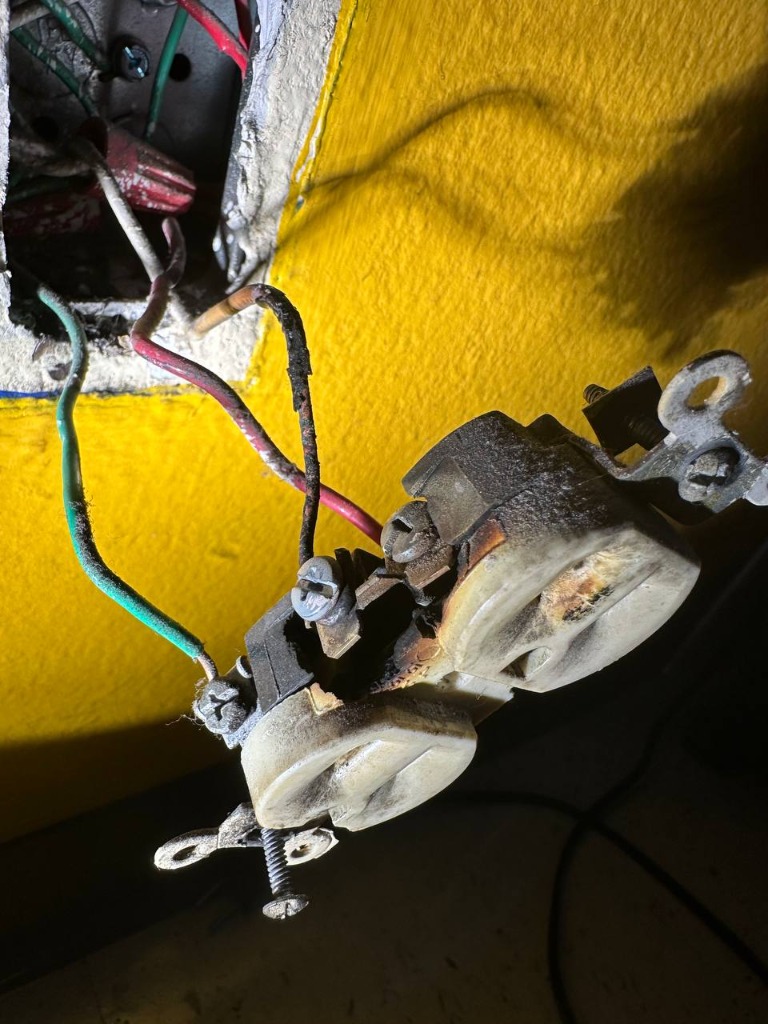
Our licensed electricians at KiloWire Electric (CSLB #1110475) recently pulled the outlet you see in the photo above directly out of a client’s wall during a routine service call in Southern California.
The homeowner called us with what seemed like a minor complaint: “The plug felt a bit loose, and we noticed a strange plastic smell a few days ago, but appliances were still working, so we didn’t think it was an emergency.”
When we cut the power and pulled the receptacle from the junction box, we found a terrifying scene: the thermoplastic body had completely disintegrated and cracked under extreme thermal stress, and the high-voltage conductor insulation had charred black down to raw copper. Just inches away behind that drywall sat wooden framing studs and dry attic dust. Had an open arc leaped, or had that connection continued drawing current under load, this family would have faced a catastrophic in-wall fire while sleeping.
According to data from the National Fire Protection Association (NFPA), home electrical fires cause hundreds of civilian deaths, thousands of injuries, and over $1.5 billion in property damage annually. The tragic reality? Almost every electrical fire is preceded by clear warning signs that homeowners brushed off.
The Science of a Thermal Meltdown: Why Standard Breakers Fail to Trip
The single most dangerous misconception homeowners have is: “If my breaker hasn’t tripped, my wiring is safe.”
Standard circuit breakers in your electrical panel are designed to protect against two specific conditions:
- Severe Overcurrent: Pulling 25 to 30 Amps continuously through a circuit wired and rated for only 15 or 20 Amps.
- Dead Short Circuits: A direct zero-resistance fault where the hot wire contacts neutral or ground, triggering an instantaneous magnetic trip.
Standard breakers are completely blind to what caused the melted outlet in our photo: a high-resistance series connection.
How a Loose Connection Becomes an In-Wall Torch
When a wire terminal screw loosens over time, or when wires are shoved into cheap push-in “backstab” spring terminals behind an outlet, the contact surface area shrinks. Under electrical physics ($P = I^2 \times R$), as electrical resistance ($R$) rises at that loose connection, electrical current converts directly into intense, localized heat.
If you plug in a space heater, coffee maker, or vacuum drawing 10 to 12 Amps:
- The 15-Amp breaker sees a completely normal load and remains on.
- Meanwhile, the loose screw junction reaches 450°F to 900°F.
- The plastic casing chars and crumbles, insulation bakes away, and oxygen feeds smoldering drywall paper inside your wall cavity.
Modern Life-Saving Upgrades: GFCI & AFCI Protection
Modern California Electrical Code (CEC Title 24 Part 3) and forthcoming NEC standards mandate advanced circuit protection precisely to stop these disasters before they ignite:
1. Ground Fault Circuit Interrupters (GFCI)
- What they do: GFCIs continuously measure the balance between hot and neutral currents. If as little as 4 to 6 milliamperes of electricity leaks away from the circuit (for instance, through a wet floor, damp wall, or a person’s body), the device cuts power in 1/40th of a second.
- Where you need them: Bathrooms, kitchens, laundry rooms, garages, basements, exterior receptacles, and any location within 6 feet of water.
2. Arc Fault Circuit Interrupters (AFCI)
- What they do: AFCI breakers contain internal microprocessors that constantly analyze the current waveform. They recognize the erratic high-frequency “noise” created by unintended sparking and micro-arcing inside wall cavities—the exact condition that caused the burn in our photo—and trip the circuit before combustibles catch fire.
- Where you need them: Bedrooms, family rooms, living rooms, hallways, and throughout older residential framing.
3. Dual-Function (AFCI / GFCI) Protection
For comprehensive defense, KiloWire installs dual-function AFCI/GFCI breakers directly in the electrical panel, giving every connected receptacle whole-home defense against both electrocution and in-wall arcing fires.
Electrical Protection Comparison
| Protection Device | What It Guards Against | How Fast It Reacts | Will It Prevent Loose-Wire Fires? |
|---|---|---|---|
| Standard Thermal Breaker | Overcurrent & Dead Shorts | Seconds to minutes | No — blind to loose terminals |
| GFCI Outlet or Breaker | Shock, Electrocution & Water Faults | 25 milliseconds (1/40 sec) | Only if current leaks to ground |
| AFCI Smart Breaker | Micro-Arcing & Sparking Connections | Instantaneous upon arc detection | Yes — shuts down arcing wires |
| Dual AFCI / GFCI | Shocks, Ground Faults & Arcing Fires | Instantaneous | Yes — complete dual protection |
5 Warning Signs You Must Never Ignore
Take five minutes today to walk through your home and look for these warning indicators:
- Warm or Hot Wall Plates: Receptacles and light switches should never feel noticeably warm to the touch. Warmth signals internal resistance heating.
- Plugs Fitting Loosely: When cords slide out of the socket under their own weight, the internal copper tension springs have failed, causing poor contact and heat buildup.
- Discoloration or Scorching: Any yellowing, brown scorch marks, or warped plastic around socket holes means arcing has already occurred.
- Acrid or “Fishy” Odor: Overheated electrical phenolic resins and PVC insulation release a distinct fishy, chemical smell long before visible flames appear.
- Flickering Lights or Sizzling Sounds: If you hear buzzing, clicking, or sizzling when an appliance runs, electricity is literally jumping through air gaps inside the wall.
Schedule an Inspection with KiloWire Electric
If you spot any of these warning signs, shut off the breaker for that room immediately and do not use the outlet.
At KiloWire Electric (CSLB Lic #1110475), our licensed electricians and electrical engineers specialize in comprehensive residential safety:
- $99 Promotional Diagnostic Visit: We inspect up to 2 outlets or 1 fixture within 10 miles of Rowland Heights (91748, +$2/mi beyond) to identify the source of the issue before repairs begin. Fee is credited toward completed work.
- GFCI & AFCI Upgrades: Retrofit your living areas, kitchen, and baths with modern code-compliant safety interrupters.
- Commercial-Grade Tamper-Resistant Outlets: Replace degraded 50-cent builder-grade receptacles with heavy-duty spec-grade hardware.
- Main Electrical Panel Upgrades: Upgrade obsolete or dangerous panels (Zinsco, Federal Pacific, or undersized 100A boxes) to robust 200A modern service.
Don’t wait for an electrical emergency to put your home and family at risk. Contact KiloWire Electric today for an expert evaluation.
📞 Call (626) 600-0818 or book online via our contact page. We serve Los Angeles County, Orange County, Whittier, and surrounding Southern California communities.