Modern home appliances make our lives more comfortable and environmentally friendly, but they also demand more power than ever before. Many homes in Southern California still operate on older 100-amp electrical panels. While 100 amps was plenty of power in the 1970s and 1980s, it is simply not enough for today’s high-draw technologies.
Recently, the KiloWire Electric team responded to an emergency service call at a residential home. The homeowner reported a sudden loss of power to key areas, a faint burning smell near the panel, and a main breaker that refused to reset.
Our diagnostic inspection revealed a classic case of electrical panel overload that was inches away from starting a devastating house fire. Here is what we found, why it happened, and how you can prevent it.
The Diagnosis: Tripped Breakers and Melted Busbars
Upon arriving at the property, our licensed electrician opened the exterior service panel. As shown in the diagnostic photo below, we immediately noticed that the circuit breakers were running extremely hot to the touch, and one of the sub-breakers had tripped completely.
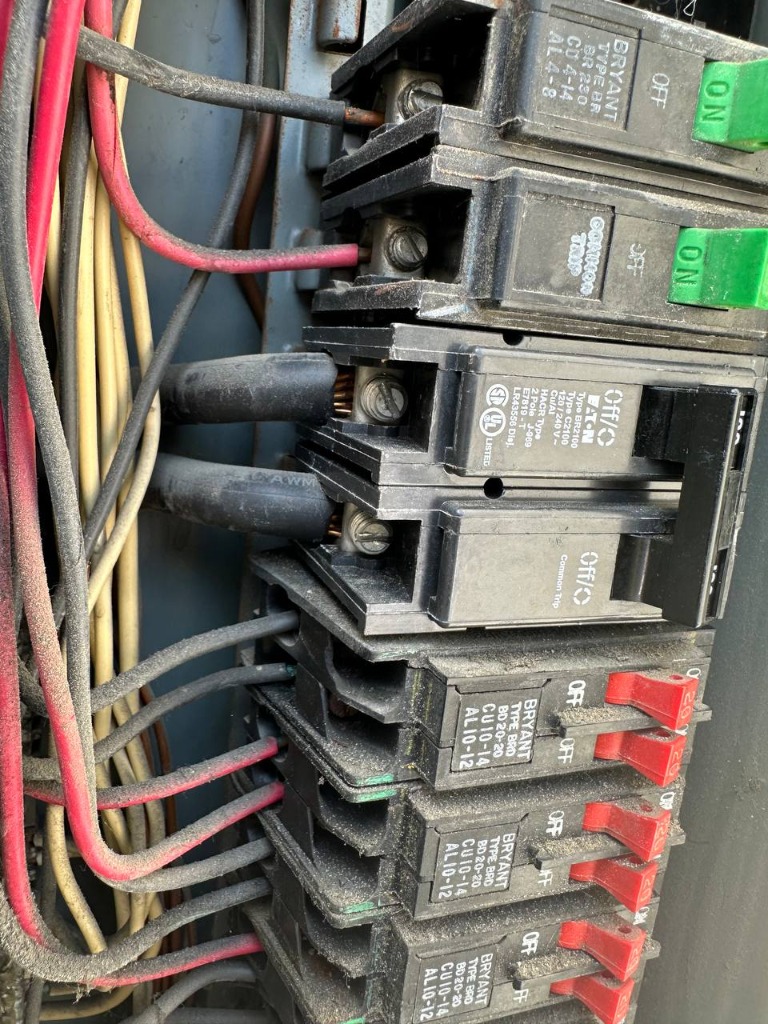 Photo 1: The electrical panel during our emergency inspection. Notice the heavy accumulation of dust and the outdated Bryant and Eaton breakers. The system was running near maximum capacity, causing the breakers to overheat and trip.
When we pulled the problematic breakers to inspect the panel interior, the true danger became clear. The electrical busbar (the metal rail that conducts electricity to the breakers) had suffered severe arcing and thermal damage.
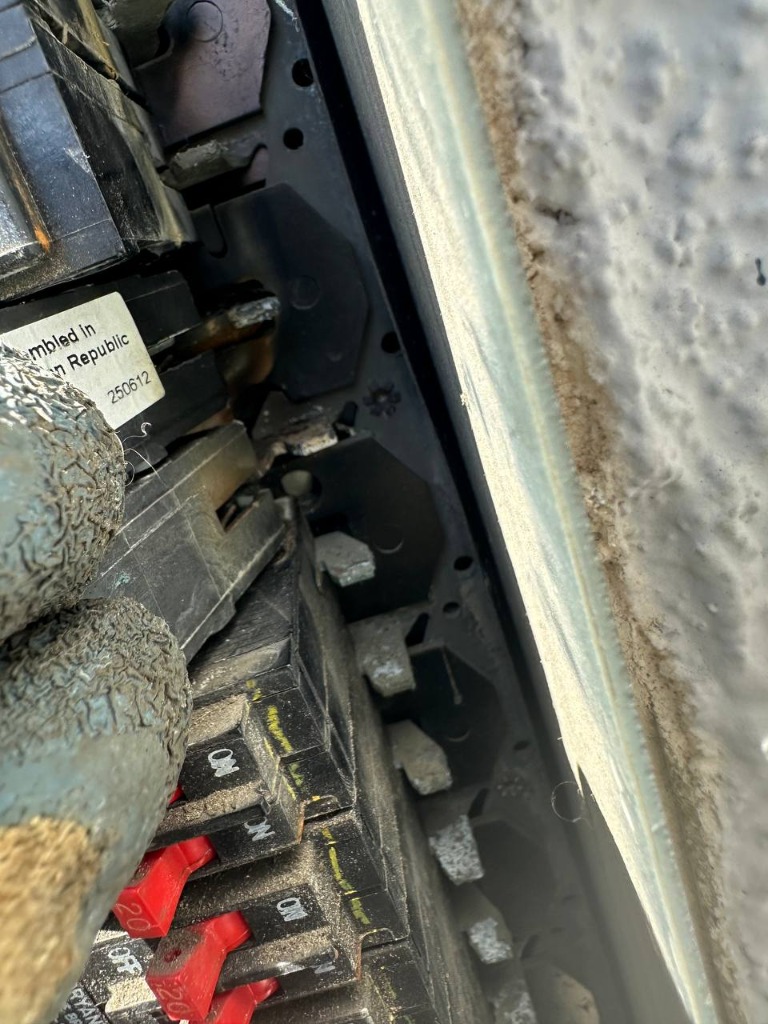 Photo 2: A close-up view of the electrical panel interior. The black soot and melted metal contacts on the busbar indicate severe overheating and electrical arcing. This is an extreme fire hazard that requires immediate replacement.
Why EV Chargers and Air Conditioners Don’t Mix on a 100A Panel
The root cause of this emergency was simple: concurrent load overload.
The homeowner had recently installed a Level 2 Electric Vehicle (EV) charger in the garage. On the day of the outage, they plugged in their EV to charge during a hot Southern California afternoon while the central air conditioning (A/C) system was running at full blast.
Let’s break down the math of this electrical draw:
- Level 2 EV Charger: Typically draws 32 to 40 amps of continuous load.
- Central Air Conditioner: Draws 20 to 30 amps when starting and running.
- Base Household Load: Refrigerator, lights, computers, and appliances easily draw another 15 to 25 amps.
When you add these up, the continuous draw easily exceeds 80 to 95 amps. In electrical safety, the 80% Rule (NEC 210.20) dictates that a circuit breaker should not be loaded to more than 80% of its capacity for a continuous load (more than 3 hours). For a 100-amp panel, the safe continuous limit is 80 amps.
Running the EV charger and the A/C at the same time pushed the panel past its physical limits. The copper and aluminum contacts inside the panel began to heat up. Over time, this heat expanded the metal, creating loose connections, arcing, and ultimately melting the busbar.
How to Protect Your Home: Upgrade to 200 Amps
If you own an EV, plan to purchase one, or are upgrading your HVAC system, you must assess your home’s electrical capacity. There are two primary ways to make your home safe:
1. Main Panel Upgrade (MPU) to 200 Amps
The most robust and permanent solution is upgrading your service panel to 200 amps. A 200-amp panel doubles your home’s electrical capacity, providing plenty of headroom to run your EV charger, air conditioner, electric dryer, and kitchen appliances simultaneously without any safety risks.
At KiloWire, we specialize in professional Panel Upgrades in Southern California. We handle the entire process:
- Securing city building permits.
- Coordinating with Southern California Edison (SCE) or LADWP for the service disconnect and reconnect.
- Installing a premium, code-compliant panel with brand new breakers and a 1-year workmanship warranty.
2. Smart EV Energy Management Systems (EVEMS)
If a panel upgrade is structurally difficult or budget-prohibitive, we can install a smart load-shedding device (like a DCC-12 or a Smart Splitter). These devices automatically pause your EV charger whenever your home’s total power draw nears 80%, resuming charge once the air conditioner cycles off.
Don’t Wait for the Sparks: Schedule a Free Panel Inspection
If you smell a faint burning odor, hear a humming or buzzing sound from your panel, or notice your lights flickering when your A/C kicks on, your panel is sending you warning signs.
Contact KiloWire Electric today for a professional electrical panel evaluation. We will run a load calculation on your home and guide you through the best safety upgrades.
- Call us directly: (626) 600-0818
- Book Online: Request an Estimate