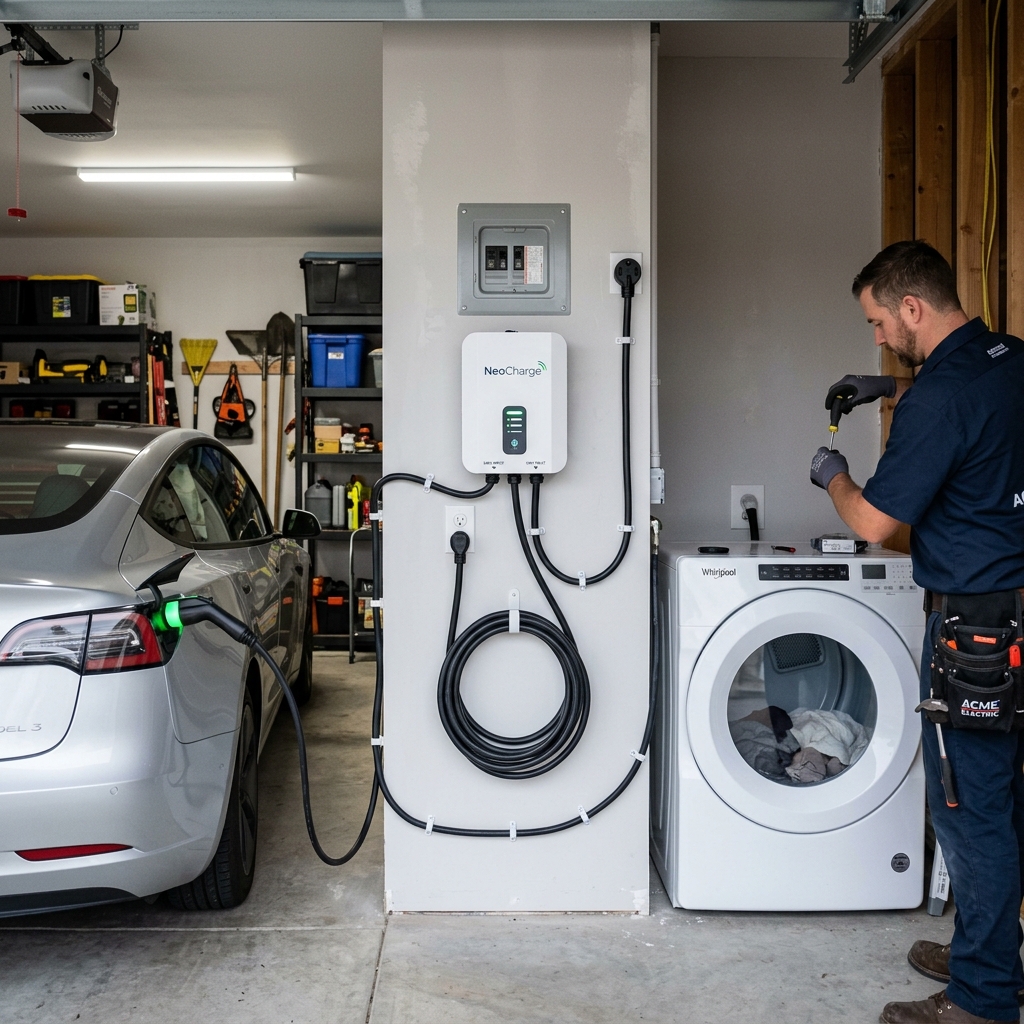
You bought an electric vehicle. You want to charge at home on Level 2 — 240V, fast overnight top-up, no more inching along at 4 miles per hour on a standard outlet. Then your electrician looks at your panel and tells you there’s no room. The panel is full. You’d need a service upgrade. Six to eight thousand dollars, minimum. Could take months.
What if you could skip all of that — and use the dryer outlet that’s already in your garage?
That’s exactly what NeoCharge’s Smart Splitter does.
What Is the NeoCharge Smart Splitter?
The NeoCharge Smart Splitter is a load-sharing device that plugs into an existing 240V outlet — a dryer receptacle, an electric range outlet, or any other NEMA 14-30 or NEMA 14-50 socket — and creates two simultaneous 240V outputs from that single circuit. One output goes to your original appliance. The other goes to your EV charger.
The “smart” part is what makes it work safely: NeoCharge monitors both loads in real time and dynamically allocates power between them. If your dryer turns on while your EV is charging, NeoCharge instantly reduces the power to the EV to keep total draw within the circuit’s rated capacity. When the dryer finishes, full power returns to the car.
No overloaded circuits. No tripped breakers. No fire risk. Just intelligent sharing.
The Physics of Why This Works
A residential dryer typically runs for 45–60 minutes per cycle. Most households run two to three loads per week. That’s roughly 2–3 hours out of every 168-hour week that the dryer circuit is actually in use.
The other 165+ hours? That 30-amp or 50-amp 240V circuit sits completely idle.
NeoCharge monetizes that idle time. When the dryer is off — which is most of the time, including all night while your EV charges — 100% of the circuit capacity goes to your car. You wake up to a full battery every morning without your dryer circuit being used for anything other than drying laundry.
The result is a Level 2 charging solution that costs a small fraction of a panel upgrade and installs in hours rather than months.
Real Charging Speeds: What to Expect
The charging speed you get from NeoCharge depends on the circuit you’re working with:
NEMA 14-30 (30A dryer circuit): NeoCharge delivers up to 24A continuous to the EV — approximately 5.8 kW. That’s roughly 20–25 miles of range per hour of charging. For a typical commuter driving 40 miles a day, this means a full overnight charge on almost any EV.
NEMA 14-50 (50A circuit, range or RV outlet): NeoCharge delivers up to 40A continuous — approximately 9.6 kW. Around 30–35 miles of range per hour. A Tesla Model Y Long Range goes from near-empty to full in about 8 hours.
For 95% of EV owners, either of these speeds is more than sufficient for daily use. The only drivers who might need more are those with very large batteries (100+ kWh) who routinely arrive home at single digits and need a full charge by morning — a scenario where a dedicated circuit with EVEMS might be a better fit.
Compatible Vehicles and Chargers
NeoCharge works with any EV and any Level 2 EVSE (charger) that accepts a NEMA 14-30 or NEMA 14-50 plug — which includes virtually every consumer Level 2 charger on the market:
- Tesla Wall Connector (with appropriate adapter or direct plug)
- ChargePoint Home Flex
- JuiceBox 40/48
- Emporia Level 2 Charger
- Grizzl-E chargers
- Siemens VersiCharge
KiloWire verifies compatibility at the assessment visit before any work is done.
Does This Require a Permit?
In most jurisdictions — including most of Los Angeles County — NeoCharge installation does not require an electrical permit because no new wiring is involved. You’re adding a device to an existing outlet, not modifying the electrical system.
However, “no permit required” does not mean “any installation goes.” There are important safety checks that need to happen before NeoCharge is deployed:
Circuit integrity: The existing outlet and wiring must be in good condition and correctly rated. An overloaded or degraded circuit is a fire hazard regardless of what’s plugged into it.
Outlet type and condition: NeoCharge is compatible with specific NEMA configurations. An older outlet in poor condition should be replaced before NeoCharge is added.
Grounding: Proper three-wire grounding is required for safe EV charging. Older two-wire dryer circuits are not compatible and cannot be used safely without an upgrade.
EV charger amperage setting: The EV charger connected to NeoCharge must be configured to the correct maximum amperage for the circuit. An improperly configured charger can draw more than NeoCharge expects.
This is why KiloWire performs a full safety assessment before installation — even for permit-exempt work. An improperly installed NeoCharge is still a liability.
What KiloWire’s Installation Process Looks Like
Step 1 — Free assessment (on-site or virtual): We review your existing outlet, circuit, panel, and EV charger. We confirm NeoCharge compatibility and identify any outlet or wiring issues that need to be addressed first.
Step 2 — Written quote: Itemized, fixed-price. No hidden fees. You know exactly what you’re paying before anyone picks up a tool.
Step 3 — Installation: A KiloWire technician installs NeoCharge, verifies the outlet condition, replaces the outlet if needed, configures the EV charger to the correct amperage, and tests the full system — both dryer cycle and EV charging — before we leave.
Step 4 — Documentation: We provide written documentation of the installation and configuration. This matters for insurance records and if you ever sell the home.
Total installation time: typically 2–4 hours. Total cost: significantly less than a panel upgrade. Timeline from assessment to installed: often same week.
Why “I’ll Just Do It Myself” Is the Wrong Call Here
NeoCharge is marketed, in part, as a DIY product. And in a narrow technical sense, plugging a device into an outlet is within most homeowners’ abilities.
But here’s what you miss without professional assessment:
A worn outlet that’s been running a dryer for 15 years may have heat-damaged contacts that are fine for occasional dryer use but will overheat under the sustained load of overnight EV charging. You won’t know until something goes wrong.
An older home may have aluminum wiring to the dryer circuit — which requires specific outlet types and torque specifications to be safely used with high-current devices. Standard outlets on aluminum wiring are a documented fire risk.
A misconfigured EV charger amperage setting can demand more current than NeoCharge is allocating, causing the NeoCharge to cycle incorrectly or the circuit to trip repeatedly.
A KiloWire assessment catches all of these in 30 minutes. The installation fee is a small fraction of what a service call after something goes wrong — or an insurance claim — would cost.
The Bottom Line
NeoCharge is one of the most cost-effective paths to Level 2 EV charging for homeowners who have an existing 240V outlet within a reasonable distance of where they park. It doesn’t require a panel upgrade. It doesn’t require SCE coordination. It doesn’t require months of waiting.
What it does require is a professional installation by a licensed C-10 contractor who verifies that your existing electrical infrastructure is actually ready to support it safely.
KiloWire is that contractor — licensed, bonded, insured, and experienced with NeoCharge installations across LA County.
Installation is performed per NEC Article 625 (Electric Vehicle Charging Systems) and all applicable Los Angeles County electrical code requirements.