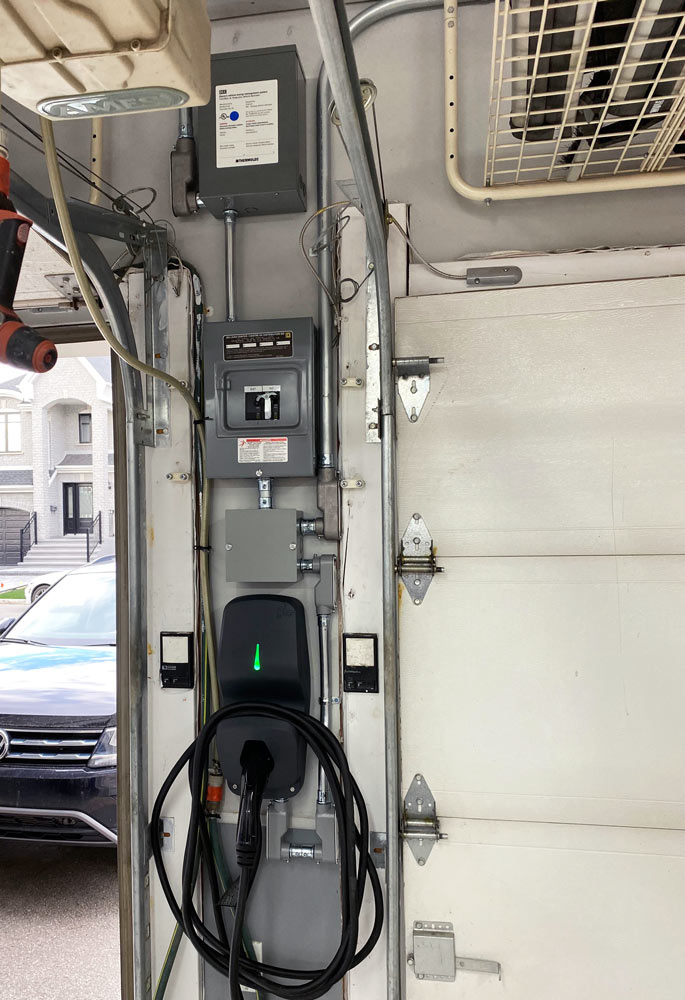
Here’s the problem in plain language: your home has a 100-amp electrical panel. It’s full. You bought an EV. A Level 2 charger needs a 40–60 amp dedicated circuit. Adding that circuit the traditional way would push your panel beyond its rated capacity — which means the permit fails, the inspector rejects it, or worse, you run the system hot and create a real hazard.
The traditional answer is a service upgrade. New meter socket, bigger feeder wires, 200A panel, SCE coordination, permits, inspections. Cost: $6,000–$15,000. Timeline: 2–6 months.
The DCC-12 EVEMS is a different answer — and it’s specifically created, UL-listed, and approved under the National Electrical Code for exactly this situation.
What EVEMS Stands For and Why It Exists
EVEMS stands for Electric Vehicle Energy Management System. It’s a category of device defined and regulated under NEC Article 625.42 — the section of the National Electrical Code that governs EV charging equipment and systems.
The code recognizes a fundamental reality: most homes don’t run all their appliances simultaneously at maximum load. The dryer, oven, AC, and water heater rarely peak at the same moment. There is, in practice, almost always headroom in a 100A panel that a standard load calculation doesn’t credit because it assumes worst-case simultaneous loads.
NEC 625.42 allows an EVEMS — a device that continuously monitors actual panel load in real time — to manage the EV charging circuit dynamically, ensuring the panel never exceeds its rated capacity even with an EV charger active. When the system is monitored and managed this way, the EV circuit can be installed on panels that would otherwise fail the standard load calculation.
The DCC-12 by RVE/Thermolec is one of the most established EVEMS products on the market and is specifically listed for this application.
How the DCC-12 Works: The Technical Picture
The DCC-12 installs at your service entrance — between the utility meter and your main panel. It includes current transformers (CTs) that clamp around your main service conductors and measure total household current draw every second.
The device continuously compares actual current draw against a configurable threshold — typically 80% of your main breaker rating (which is itself the NEC’s continuous load limit). For a 100A panel, that threshold is 80A.
When household load is below 80A: The DCC-12 allows full power to flow to the EV charger circuit. Your EV charges at its maximum rate.
When household load approaches or exceeds 80A: The DCC-12 interrupts power to the EV charger circuit until the household load drops back below the threshold and stays there for a configurable period (default: 15 minutes).
Net result: The EV charger and the rest of your home share the panel’s capacity, with the EVEMS ensuring the two never overlap at unsafe levels. From the NEC’s perspective, the EV circuit is conditionally managed — and the load calculation standard that would otherwise block the permit doesn’t apply.
The Legal Foundation: NEC Article 625.42
This is not a workaround. This is not a loophole. This is an explicit provision in the National Electrical Code, adopted in California as part of Title 24 electrical standards.
NEC 625.42 states, in summary: an EVSE may be connected to a service or feeder that does not have sufficient capacity under the standard load calculation, provided that an EVEMS is installed that continuously manages the EV charging load to prevent the service or feeder from being overloaded.
The implications:
- The EV circuit can be added to your existing 100A panel via a standard breaker — as long as the DCC-12 is in place
- The permit can be approved based on the EVEMS compliance, not the standard load calculation
- No service upgrade is required
- No SCE coordination beyond the normal permit process is required
This is why inspectors across LA County now routinely approve DCC-12 installations on 100A panels. The product has been on the market long enough that the AHJ (Authority Having Jurisdiction — i.e., the building department) is familiar with it.
What the DCC-12 Actually Delivers
Service compatibility: Works with residential services up to 200A (100A is the most common use case).
EV circuit capacity: Supports EVSE circuits up to 60A — which covers every Level 2 charger currently on the consumer market, including Tesla’s 48A Wall Connector.
Weatherproofing: NEMA-3R rated enclosure. Can be installed outdoors, in a garage, or at the service entrance exterior.
Simplicity: No Wi-Fi, no app, no subscription, no firmware updates. The device monitors current and controls the EV circuit relay. That’s it. Simple systems are reliable systems.
Code compliance: UL listed. Compliant with NEC 625.42. Accepted by building departments across Los Angeles County.
The Real-World Charging Experience
The most common concern: “Will my car actually charge, or will it keep getting interrupted?”
The honest answer: for 99% of drivers, in real-world use, the DCC-12 interrupts EV charging so rarely that you won’t notice it.
Here’s why. The heavy loads in a home — oven, dryer, air conditioner — don’t run continuously. They cycle on and off. More importantly, EV charging almost always happens overnight, when most other loads are minimal. The combination of lower overnight household load and the DCC-12’s 15-minute re-enable window means the charger runs uninterrupted through the night in almost all normal scenarios.
The 1% exception: if you regularly cook dinner, run the dryer, and need a full charge simultaneously in a 4-hour window, the DCC-12 may introduce interruptions. In that edge case, a ConnectDER (new pre-panel circuit) or a SPAN panel (full load management) might be a better fit. KiloWire will identify this at the assessment.
Who Should Consider the DCC-12
Ideal candidate:
- Home with 100A service, full panel with one breaker slot open
- EV charger is the primary addition — no simultaneous heat pump, new HVAC, or major load additions planned
- Budget-conscious solution preferred over SPAN or ConnectDER
- Overnight charging pattern (most drivers)
Consider alternatives if:
- Panel has zero breaker slots (ConnectDER or NeoCharge may fit better)
- Adding multiple large loads simultaneously (SPAN whole-panel management)
- Need maximum charging speed guaranteed at all times regardless of house load (dedicated circuit via ConnectDER)
KiloWire’s DCC-12 Installation: What’s Included
Free assessment: Panel evaluation, load calculation review, EVEMS suitability confirmation, permit requirement identification, SCE Charge Ready Home rebate eligibility check.
Permit: KiloWire pulls the electrical permit before work begins. The permit documents the NEC 625.42 EVEMS compliance path, which is what allows the inspector to approve the installation.
Installation: DCC-12 installed at service entrance; current transformers installed on main service conductors; EV circuit breaker installed in panel; conduit and wiring run to EVSE location; Level 2 charger installed and commissioned.
Current transformer calibration: The CTs must be correctly sized and installed for the DCC-12 to accurately measure panel load. This is a critical step that requires the right tools and experience.
System testing: KiloWire tests the full installation — including simulating load conditions to verify the DCC-12 responds correctly — before sign-off.
Inspection: We coordinate and attend the electrical inspection. Inspection approval documents are provided.
1-year workmanship warranty. All work performed under CSLB License #1110475 (C-10). Bonded. Workers’ comp + $1M general liability.
What Goes Wrong With Improperly Installed EVEMS
The DCC-12 is a protection device. An improperly installed protection device is worse than no protection device — because it creates false confidence.
Common installation errors we’ve seen from non-specialist contractors:
Incorrectly sized current transformers: CTs must match the service conductor size. Wrong CTs = inaccurate current readings = DCC-12 either cuts EV charging too aggressively or doesn’t cut it soon enough.
CTs installed on wrong conductors: CTs must be on the main service conductors, not on individual panel feeds. Installed incorrectly, the DCC-12 doesn’t see your actual total load.
Threshold set incorrectly: The DCC-12’s trip threshold must be set relative to your panel’s actual rating. Set too high, the system doesn’t protect adequately. Set too low, EV charging gets interrupted constantly.
No permit: Without a permit and inspection, the EVEMS compliance path is not documented. An inspector finding an unpermitted EVEMS installation may require removal and full re-work.
KiloWire has installed DCC-12 systems across LA County. We know exactly how to size, place, and calibrate them — and we back every installation with a permit and a signed warranty.
All installations comply with NEC Article 625.42, California Title 24 Electrical Standards, and applicable Los Angeles County Electrical Code.