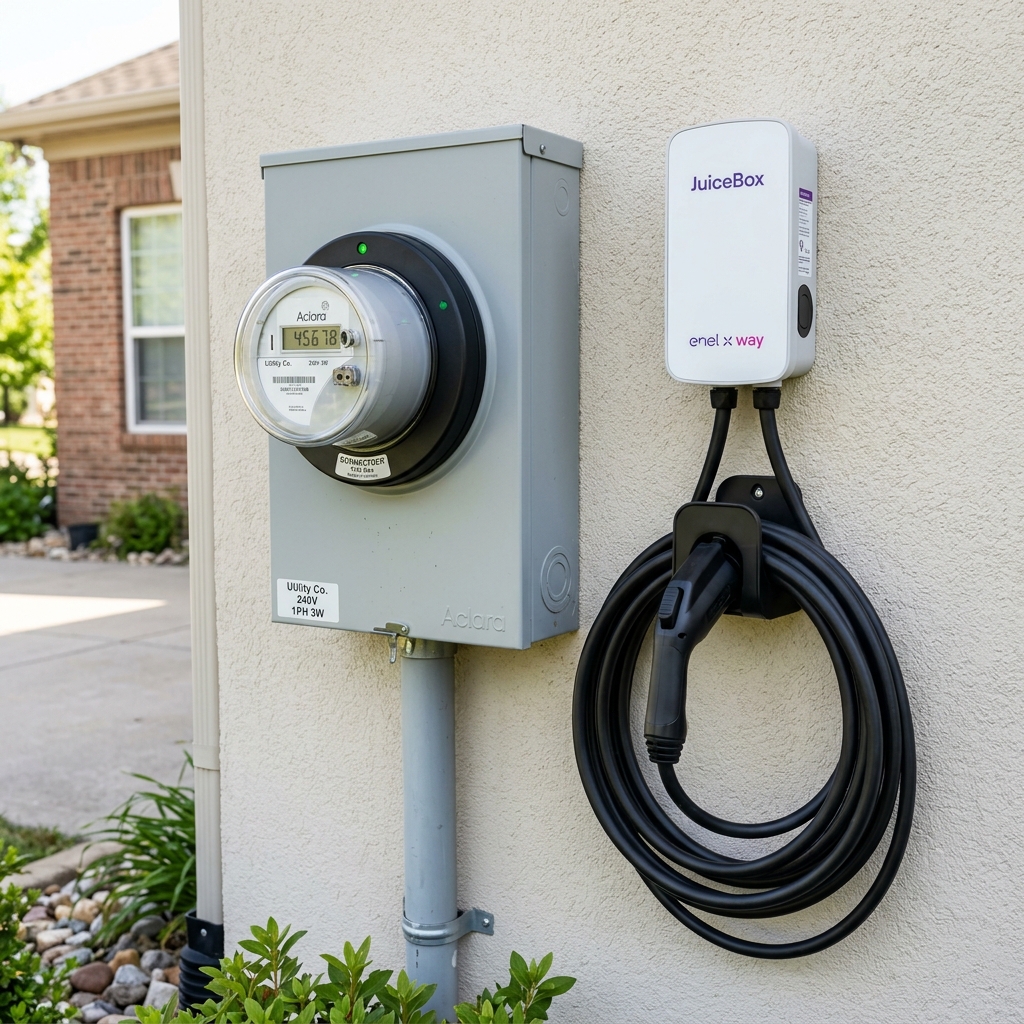
Your electrical panel is full. Every breaker slot is taken, and adding a 40–50 amp EV circuit the traditional way would mean either a costly service upgrade or consolidating existing circuits — neither of which is cheap, fast, or simple.
ConnectDER’s Meter Socket Adapter (MSA) takes a completely different approach. Instead of working inside your panel, it works before your panel — at the utility meter itself — and creates a new 240V circuit without touching a single existing breaker.
It’s one of the most elegant solutions in modern residential electrical engineering. And it requires a licensed, authorized installer to be done correctly and legally.
Where Your Panel Actually Gets Its Power
To understand why ConnectDER works, it helps to understand the physical layout of your home’s electrical system.
Power from the utility grid arrives at your home through the service entrance cables — large wires running from the street (or underground) to your meter socket. Your electric meter plugs into this socket and measures consumption. From the meter, power flows into your main electrical panel, where it’s distributed to individual circuits through breakers.
The key point: the meter socket sits between the utility and your panel. It has full service voltage (typically 240V, split-phase) and full service amperage available — before any panel limitations apply.
ConnectDER installs at the meter socket and taps a new branch circuit directly from this pre-panel power source. The EV charging circuit comes off the ConnectDER, not off any breaker in your panel. Your panel never sees the EV load at all.
What ConnectDER Actually Is
The ConnectDER MSA is a meter socket adapter — a mechanical component that fits between your existing meter and your existing meter socket. It’s UL-listed, utility-compatible, and designed for residential installations across SCE, LADWP, and other California utilities.
Physically, it looks like a collar or ring that the meter passes through. Inside that collar is the tap point for your new EV circuit, a disconnect, and the necessary safety components.
Once installed, you have:
- Your existing meter still working exactly as before
- A new dedicated 240V circuit (up to 60A capacity) for your EV charger
- No changes to your main panel
- No new breakers
- No service upgrade
The EV charger connects to this new circuit and is installed wherever it needs to be — garage wall, carport post, driveway pedestal.
Why This Is Legal and Code-Compliant
ConnectDER installations comply with NEC Article 230 (Services) and NEC Article 625 (Electric Vehicle Charging Systems). The device is specifically designed and listed for use in residential meter socket applications.
The installation does require a permit in most jurisdictions because it involves work at the service entrance — the highest-consequence point in your home’s electrical system. A permit means an inspector reviews the work and confirms it meets all applicable code requirements.
This is not optional, and KiloWire never skips it.
The inspection process for ConnectDER installations is straightforward because the device is already listed and its installation methodology is standardized. Inspectors in LA County are increasingly familiar with it as EV adoption grows.
What the permit and inspection protect:
You: If something goes wrong with an unpermitted installation, your homeowner’s insurance can deny the claim. An inspected and approved installation is on record.
Future buyers: An unpermitted service entrance modification is a serious red flag in any home sale inspection. A permitted ConnectDER installation is documented and legal.
SCE rebate eligibility: The SCE Charge Ready Home program requires permitted installations by licensed C-10 contractors. Unpermitted work is ineligible.
The Utility Coordination Reality
Because ConnectDER modifies the meter socket — the point where utility infrastructure meets your home — it requires a brief coordination with SCE (or your serving utility). Specifically:
The installation requires a brief power interruption at the meter to physically install the adapter. This is coordinated with SCE and typically happens as part of the installation day. It’s not a multi-week coordination process like a service upgrade — it’s a scheduled outage of a few hours, handled by KiloWire as part of the installation.
What ConnectDER does not require:
- SCE grid capacity analysis (because you’re not increasing your service amperage)
- New transformer work
- New utility cables or overhead/underground service changes
- Any SCE equipment replacement
The service stays exactly as it was. You’re just tapping it at a new point.
Who ConnectDER Is Right For
ConnectDER is the right solution when:
Your panel is genuinely full — no available breaker slots, or consolidating existing circuits would require significant rewiring.
You don’t have a convenient 240V outlet near where you park — so the NeoCharge Smart Splitter isn’t an option.
You want a fully dedicated EV circuit — not shared with any other appliance, running at maximum allowable amperage for your charger.
You’re on 100A service and don’t need or want to upgrade to 200A — ConnectDER supports EV circuits on 100A services by managing the tap appropriately.
You want a clean, permanent installation that adds real value to the home and will satisfy any inspector or future buyer without question.
Where ConnectDER may not be the best fit:
If you already have a 240V outlet in the right location, NeoCharge may be faster and less expensive. If your panel has one slot open and you want the simplest possible path, an EVEMS load controller (DCC-12) might work. KiloWire will identify the right solution at the assessment — we don’t push ConnectDER when simpler options apply.
Charging Speed: What ConnectDER Delivers
A ConnectDER-based installation can support an EV charging circuit up to 60A capacity (though 48A is the practical maximum for most Level 2 chargers on the market). At 48A, you’re looking at approximately 11.5 kW — enough to add roughly 35–40 miles of range per hour of charging.
For context:
- A Tesla Model 3 Standard Range goes from 20% to 100% in approximately 5 hours
- A Ford F-150 Lightning (131 kWh battery) fills overnight in about 12 hours
- A Rivian R1T with the large battery completes overnight on 48A without issue
ConnectDER delivers the same charging speed as a traditionally wired dedicated circuit. There’s no compromise on performance.
What the KiloWire Installation Covers
KiloWire is an authorized ConnectDER installer. Here’s exactly what our installation scope includes:
Assessment (free): Meter socket compatibility check, utility identification, permit requirements, SCE rebate eligibility, EV charger compatibility, and site survey for the charger location.
Permit: KiloWire pulls the required electrical permit before work begins. You receive permit documentation as part of project close-out.
SCE coordination: We schedule and manage the meter outage window with SCE. You don’t make any calls to the utility.
Installation: ConnectDER adapter installed at meter socket; circuit run from adapter to charger location (trenched underground or surface-conduit mounted as appropriate); Level 2 EVSE installed and commissioned.
Inspection: KiloWire coordinates and is present for the electrical inspection. Inspection documentation is provided to you.
Written warranty: 1-year workmanship warranty on all KiloWire installation work, plus full manufacturer warranty on ConnectDER hardware and EVSE equipment.
All work is performed per NEC Article 230, NEC Article 625, and applicable Los Angeles County Electrical Code. CSLB License #1110475 (C-10). Bonded. Workers’ comp + $1M general liability on every project.
A Note on DIY and Unlicensed Installation
ConnectDER installations involve the service entrance — the point in your home’s electrical system with the highest voltage, highest available fault current, and the most serious consequences of an error. This is not discretionary territory for DIY work.
Beyond the safety issue, unlicensed work at a meter socket can:
- Trigger utility violation notices and forced disconnection
- Void your homeowner’s insurance
- Create legal liability in a home sale
- Disqualify you from SCE Charge Ready Home rebates
KiloWire installs ConnectDER correctly, legally, and with full permit documentation — so you have a charging solution that you can use with confidence and disclose without hesitation.