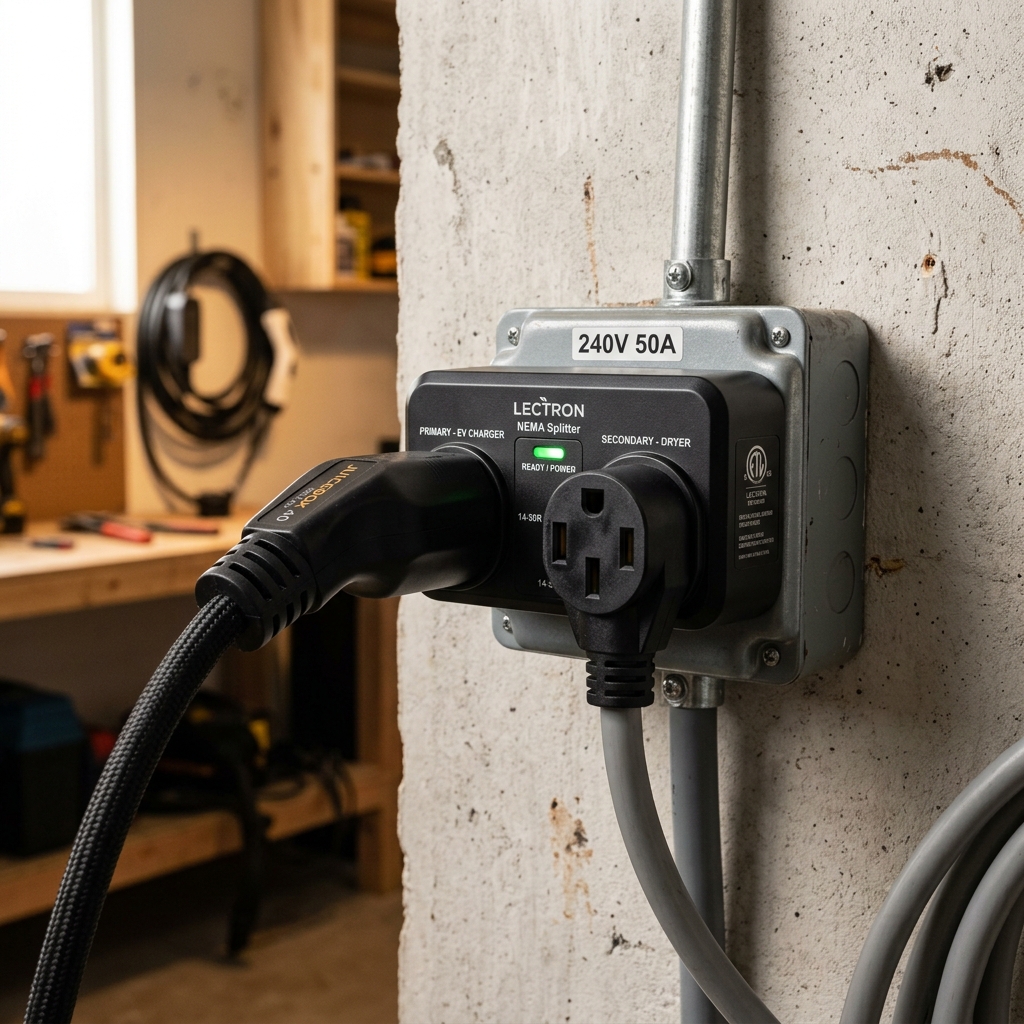
The single biggest obstacle to Level 2 EV charging at home isn’t finding the right charger — it’s the electrical panel. Most homes built before 2010 have a 100A service with a full panel. Adding a 40–60A EV circuit the traditional way means an expensive service upgrade, SCE coordination, permits, and months of waiting.
Two technologies have changed this: smart load-sharing splitters (NeoCharge) and meter socket adapters (ConnectDER). Neither requires touching your main panel. Neither requires SCE grid coordination. Both are code-legal when properly installed.
Here’s how they work.
The Core Problem: Why Panels Fill Up
A standard 100A residential panel has roughly 80A of usable continuous capacity (the NEC requires an 80% derating on continuous loads). Between an electric range (40–50A), a dryer (30A), an AC unit (15–30A), and a water heater (30A), many homes are already running at 80–90% of panel capacity during peak evening hours.
Add a 48A EV charger on top of that, and you’re looking at simultaneous demand that exceeds the panel rating — triggering breakers, damaging equipment, or simply being rejected outright by the inspector when you try to pull the permit.
The traditional solution is a service upgrade: replace the meter socket, upgrade the feeder wire, coordinate with SCE for a new or larger transformer, and install a 200A panel. Cost: $5,000–$15,000. Timeline: 3–6 months.
Smart load management takes a different approach entirely.
Solution 1: NeoCharge Smart Splitter
What it is: A device that plugs into an existing 240V outlet — typically a dryer or electric range receptacle — and shares that circuit between your EV charger and the original appliance.
How it works: NeoCharge monitors both loads in real time. When your dryer or range is running, NeoCharge reduces the power available to the EV charger proportionally. When the appliance is idle — which is most of the time — the EV charger gets the full circuit capacity.
The key insight: a dryer runs for 45 minutes, twice a week. The other 167+ hours, that 240V outlet is completely idle. NeoCharge monetizes that idle capacity without any electrical work.
What you need:
- An existing 240V outlet (NEMA 14-30 for a dryer, NEMA 10-30 for an older dryer, NEMA 14-50 for an electric range)
- An EV charger with a compatible plug (most Level 2 chargers are compatible)
- That’s it
Installation: In most cases, NeoCharge is a true plug-and-play device. A KiloWire electrician can verify the outlet, the circuit rating, and compatibility with your specific EV charger — typically a 1–2 hour visit. No permit required in most jurisdictions because no new wiring is involved.
Limitations: NeoCharge is limited by the existing circuit capacity. A 30A dryer circuit yields about 24A of usable EV charging (80% of 30A). A 50A range circuit gives you up to 40A. If your EV has a large battery and you’re doing high daily mileage, this may be slower than you’d like — though for 95% of drivers it’s more than sufficient overnight.
Solution 2: ConnectDER Meter Socket Adapter (MSA)
What it is: A device that installs between your electric utility meter and your meter socket — at the utility side of your electrical system, before power ever reaches your main panel.
How it works: The ConnectDER MSA creates a new branch circuit directly from the meter, bypassing the main panel entirely. Your EV charger connects to this new circuit. Because the power tap happens before the panel, it doesn’t consume any breaker slots, doesn’t add load through your existing panel wiring, and doesn’t require any panel modification.
What you need:
- A compatible meter socket (ConnectDER supports most common meter socket types in SCE territory)
- An authorized ConnectDER installer (KiloWire is certified)
- A permit, since this involves work at the service entrance
Installation: A KiloWire team installs the ConnectDER adapter in the meter socket — a process that takes a few hours and requires a brief power interruption coordinated with SCE. The EV charger circuit runs from the ConnectDER to wherever the charger will be mounted (garage wall, driveway, carport). A permit is required, and an inspection confirms the installation is code-compliant.
Capacity: ConnectDER supports EV charging circuits up to 48A — enough for most Level 2 chargers including Tesla’s Wall Connector at 48A. This is not a limitation for any current production EV.
The critical distinction from NeoCharge: ConnectDER doesn’t share a circuit — it creates a new one. It’s better suited for homes where there’s no convenient existing 240V outlet near where the charger will live, or where the homeowner wants a dedicated EV circuit without adding anything to the main panel.
How to Choose: NeoCharge vs. ConnectDER vs. EVEMS
| Factor | NeoCharge | ConnectDER | EVEMS (DCC-12) |
|---|---|---|---|
| Panel modification needed | None | None | One breaker |
| Permits typically required | No | Yes | Yes |
| SCE coordination required | No | Minor | No |
| Max charging speed | 24–40A | 48A | 48A |
| Best for | Existing 240V outlet nearby | No available outlet, full panel | Panel has 1 slot open |
| Install time | 1–2 hours | Half day | 1 day |
| Typical cost (installed) | $600–$1,000 | $900–$1,500 | $1,200–$2,000 |
The Permit Question
KiloWire always recommends the permitted path. Here’s why it matters for EV charging specifically:
Insurance: An unpermitted EV installation can void your homeowner’s insurance coverage for fire damage related to the charging system. EV charger fires, while rare, do happen — and an unpermitted installation hands the insurance company an easy denial.
Resale: When you sell your home, the buyer’s inspector will look for unpermitted electrical work. An unpermitted EV circuit becomes a negotiating point — or a deal-breaker.
SCE rebates: The SCE Charge Ready Home program (up to $4,200) requires that the installation be performed by a licensed C-10 contractor following all permitting requirements. Unpermitted installations are ineligible.
KiloWire handles the permit on every applicable installation. For NeoCharge (which is typically permit-exempt as a plug-and-play device), we still do a thorough safety assessment of the circuit.
What KiloWire Does at Your Assessment
When you schedule a free EV charging assessment with KiloWire, here’s what we evaluate:
- Panel review: Current load, available capacity, breaker condition, service rating
- Existing outlet inventory: Location, circuit rating, and compatibility with NeoCharge or direct charger connection
- Meter socket type: ConnectDER compatibility check
- SCE rebate eligibility: Charge Ready Home program qualification
- EV and charger compatibility: Your specific vehicle’s onboard charger capacity and the right EVSE for your situation
- Written recommendation: Which path makes sense for your home, with a line-item quote
The assessment is free for projects over $1,000. Most EV charging projects easily qualify.