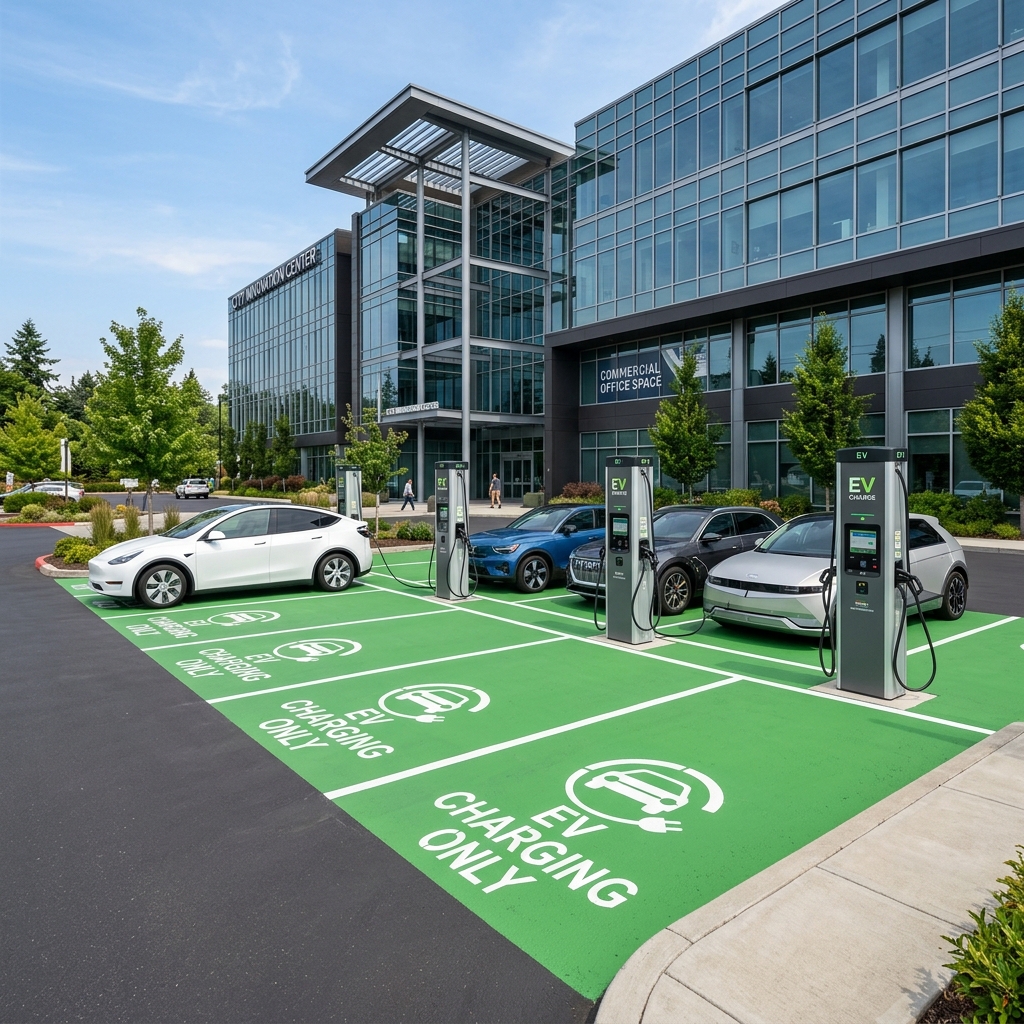
If your HOA or condo association is planning any parking lot work that requires a building permit — resurfacing, restriping under permit, adding spaces, lighting upgrades, structural repairs — you’re about to trigger California’s updated CALGreen EV requirements. And you have until December 31, 2025, to plan for compliance before the January 1, 2026 effective date.
This guide covers exactly what’s required, how to get it funded, and how to present this to your board.
What CALGreen 2026 Actually Requires
California’s Green Building Standards Code (Title 24, Part 11) updated EV infrastructure requirements effective January 1, 2026. The key trigger language is important to understand:
The trigger: Any alteration, addition, or renovation to a parking facility that requires a building permit.
This means a permit for parking lot resurfacing, adding ADA-compliant curb cuts, installing new lighting, or adding parking spaces can all trigger the EV requirements. It is not limited to full parking lot reconstruction.
For multifamily residential (5+ units):
- 10% of total parking spaces must be EV-capable (conduit, pull boxes, and panel capacity for future EV charging, but no EVSE equipment required)
- 5% of total parking spaces must be EV-ready (above plus 208/240V outlet installed at the space)
- If 20+ units: At least 1 EVSE (actual charging station) must be installed
For mixed-use with residential component:
- Apply the residential standard to the residential spaces, commercial standard to commercial spaces
For common areas and guest parking: Apply the percentage requirements to the total count including common and guest spaces.
Understanding the Three Tiers
CALGreen uses a tiered vocabulary that’s worth understanding before your board asks questions:
EV-capable: The raceway (conduit) is installed from the electrical panel to the parking spaces, with pull boxes at intermediate points. No wiring, no outlet, no charger. This is the minimum — cheap to do during construction or renovation, expensive to retrofit later. Estimated cost: $500–$2,000 per space.
EV-ready: Everything above, plus a 208/240V outlet installed at the space. No actual EVSE (charger) equipment, but a resident can plug in a personal Level 2 charger. Estimated cost: $1,200–$3,500 per space, depending on panel distance.
EVSE installed: A complete Level 2 charging station, hard-wired, networked (for managed charging), and fully operational. This is what most residents actually need and what the “Communities in Charge” grant will fund. Estimated cost: $3,000–$8,000 per port, before grants.
The Grant Opportunity Your Board Needs to Know About
The single most important financial fact for your HOA board: Communities in Charge grants provide up to $8,500 per Level 2 charging port for eligible properties in disadvantaged or underserved communities in California.
Many multifamily properties in LA County — including in cities like Whittier, Rowland Heights, Baldwin Park, and El Monte — qualify based on CalEnviroScreen designations. You won’t know until you check, which is something KiloWire verifies at no cost during the initial site assessment.
A realistic scenario for a 40-unit building requiring 5% EVSE:
- Required EVSE: 2 ports (5% of 40 = 2)
- Installed cost before grant: ~$12,000–$14,000
- Communities in Charge grant: up to $17,000 (2 × $8,500)
- Net cost to HOA: $0 — the grant exceeds the installation cost
For properties that qualify, the math makes CALGreen compliance essentially free — or better. The grant funds are allocated competitively, so timing matters. Properties that apply early in the 2026 cycle have significantly better grant access than those who wait until their permit forces the issue.
How to Get Your HOA Board to Approve This
From experience working with HOA boards across LA County, here’s what moves the vote:
Lead with compliance risk, not opportunity. Boards respond to liability. Frame the conversation as: “If we do the parking lot work we’re planning and don’t address the CALGreen requirements, we’ll fail inspection and won’t get a Certificate of Occupancy. Here’s how we solve it — and potentially make money doing it.”
Present the grant math first. The moment board members see a scenario where grant funding covers or exceeds the installation cost, the conversation shifts from “can we afford this” to “how do we qualify.”
Address the assessment fee. KiloWire provides free compliance audits for projects over $2,000. Bring the written assessment to the board meeting — it tells them exactly what’s required, what it costs, and what grant funding is available. This turns an abstract policy discussion into a concrete decision.
Plan the work together. CALGreen EV requirements are triggered by the permit for the other parking lot work. If you coordinate the EV installation with the planned renovation, you avoid a second mobilization fee, a second permit, and a second SCE coordination process. The total cost of doing it together is significantly less than doing it separately.
The Timeline: When to Start
Now (if your renovation is in 2026): Apply for grant funding immediately. Communities in Charge has limited annual allocation. The grant application process takes 4–8 weeks. If you plan to pull a parking renovation permit in spring or summer 2026, your grant application needs to be in by January.
Permit application: CALGreen compliance is verified at permit issuance. The building department will ask for your EV plan as part of the permit package. KiloWire prepares this documentation.
Construction coordination: The EV work — conduit, panel upgrades, charger installation — should be sequenced with the parking renovation, not after. Trenching for conduit while the parking lot is already torn up costs a fraction of doing it as a separate project.
Inspection: The EV infrastructure is inspected as part of the overall parking project. Our permit documentation ensures this goes cleanly.
What “One Contractor for Everything” Means in Practice
Most electrical contractors handle the EVSE equipment and wiring, but send a separate GC for the civil work: asphalt cutting, concrete, conduit trenching. That means two contracts, two schedules, two sets of coordination, and two markups.
KiloWire holds both a General Building (B) and Electrical (C-10) CSLB license. Our crew handles:
- Asphalt cutting and patching
- Concrete work for bollards and conduit penetrations
- Conduit trenching and installation
- Panel capacity upgrades
- EVSE equipment procurement and installation
- Permit documentation and inspection coordination
- Grant application management
One contract. One schedule. One point of contact for your board and property manager.
Checklist for Your First Board Meeting
Use this to structure the discussion:
- Identify the planned parking renovation and confirm it requires a building permit
- Calculate total parking spaces (including guest and common)
- Calculate required EV-capable, EV-ready, and EVSE counts under CALGreen
- Check CalEnviroScreen designation for Communities in Charge eligibility
- Schedule KiloWire free compliance audit
- Bring written assessment and grant estimate to board vote
- File grant application (if eligible) before pulling permit
- Coordinate EV installation with parking renovation timeline
KiloWire handles everything after the first bullet. The compliance audit is free, the grant application is managed by us, and the written assessment gives your board the numbers they need to make an informed vote.