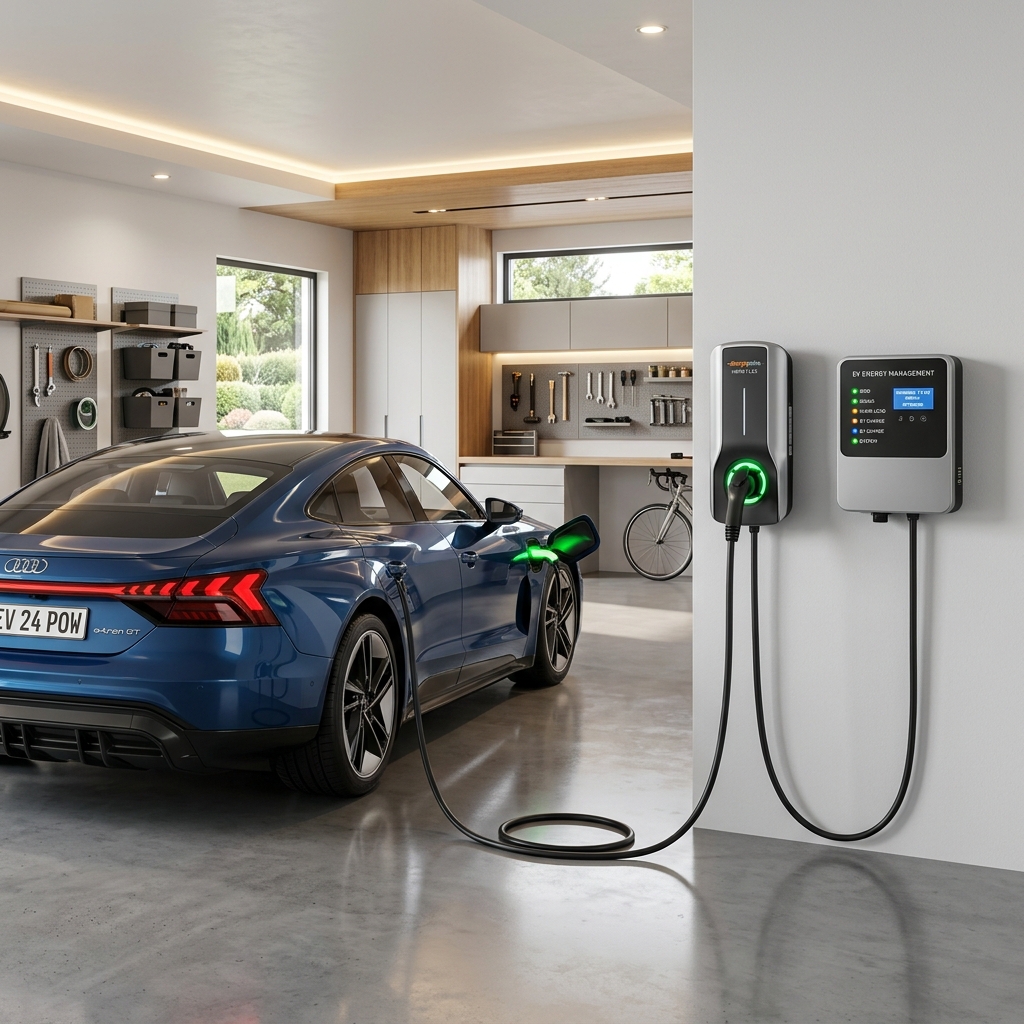
Most homeowners assume adding an EV charger means upgrading their electrical panel. Most of the time, that assumption costs them $10,000 and four months of waiting. Here’s what your electrician probably hasn’t told you yet.
The Problem Nobody Talks About
You just bought an electric vehicle. You want Level 2 charging at home — 240V, fast overnight top-up, no more relying on a slow 120V outlet. Seems simple.
Then you call an electrician. They look at your panel, shake their head, and say: “You’re on 100A service. There’s no room. You need a service upgrade first.”
That quote? Somewhere between $8,000 and $15,000. Permitting alone can take 2–4 months. And in Ontario — especially in newer suburbs — utilities are already backlogged.
Here’s the thing: in most cases, you don’t need that upgrade. What you need is an Electric Vehicle Energy Management System — or EVEMS.
What Is an EVEMS?
An EVEMS (also called an EV load controller or demand controller) is a smart device that sits between your utility meter and your main electrical panel. Its job is simple but powerful: it monitors your home’s total electrical consumption in real time and manages your EV charger accordingly.
Think of it as a traffic controller for electricity. When your home is using a lot of power — oven on, dryer running, air conditioner blasting — the system temporarily pauses EV charging. The moment demand drops, charging resumes automatically.
The result: your EV charger shares your existing electrical capacity intelligently, instead of competing with the rest of your home.
The Device Behind the Technology: DCC-12 by RVE/Thermolec
One of the most proven EVEMS solutions on the Canadian market is the DCC-12, manufactured by RVE (Recharge Véhicule Électrique) / Thermolec — a Canadian company that’s been in this space long enough that most AHJs (Authorities Having Jurisdiction, i.e., the inspectors who approve electrical work) already know and accept it. No surprises at inspection.
Key specs:
- Works with panels up to 200A service
- Supports EV chargers up to 60A (handles Tesla on 48A continuous, no problem)
- NEMA-3R rated — can be installed outdoors
- Built-in circuit breaker for the EV circuit
The logic is transparent and reliable: when total home load exceeds 80% of your main breaker rating, the DCC-12 cuts power to the EV charger. When load drops below that threshold and stays there for 15 minutes, charging resumes. No apps, no subscriptions, no firmware to update.
Is This Legal? Yes — NEC Article 625.42 Says So
This isn’t a workaround. It’s a code-compliant solution recognized under NEC Article 625.42 (Electric Vehicle Energy Management Systems).
The code allows installers to omit the EV charger from the standard electrical load calculation — provided a certified EVEMS actively manages that load in real time. In plain language: if the system guarantees the charger won’t push your panel beyond safe limits, the panel doesn’t need to be upgraded just to accommodate it.
This is why a properly installed EVEMS passes inspection. KiloWire handles the full permitting process, so you don’t have to worry about any of that.
Real Numbers: What You Actually Save
| Path | Cost | Timeline |
|---|---|---|
| Panel upgrade (100A → 200A) + EV charger | $10,000–$15,000+ | 2–4 months |
| EVEMS (DCC-12) + EV charger installation | $1,500–$2,000 | 1–2 weeks |
That’s not a small difference. That’s the difference between charging your car this month and charging it sometime in autumn.
Will My Car Still Charge Properly?
This is the first question everyone asks. The answer for 99% of drivers: yes, absolutely.
Here’s why: most people charge their car overnight, when the house is quiet. The oven is off. The dryer is done. The AC isn’t running at full blast. During those hours, the EVEMS almost never interrupts charging at all — there’s simply no reason to.
Your car doesn’t need to charge at full power constantly. It needs to be charged by morning. Those are very different requirements, and the DCC-12 handles the second one reliably.
The 1% exception: if you drive two shifts and need a full charge in a 4-hour window during peak evening hours, an EVEMS may not be the right fit. That’s a conversation worth having upfront — and it’s one KiloWire will have with you before recommending anything.
When EVEMS Is the Right Choice (And When It Isn’t)
An EVEMS is the right choice when:
- You have a 100A panel and adding EV charging pushes you over capacity
- Your primary goal is EV charging — not a full home electrification upgrade
- You want the fastest, most affordable path to Level 2 charging
- You don’t currently have plans for a heat pump, battery backup, or other major loads
It may not be enough if:
- You’re also adding a heat pump, heat pump water heater, or battery storage — those are large loads the DCC-12 doesn’t manage
- You want whole-home load management across multiple circuits
- You’re planning a full electrification overhaul where a panel upgrade makes financial sense anyway
In those cases, KiloWire can walk you through options like whole-panel smart load management systems or battery-based solutions. We’ll tell you what actually fits your situation — not what’s most expensive.
Why Professional Installation Matters
The DCC-12 involves work at the service entrance — the point where power enters your home. This is not a DIY project, and it’s not a job for a general handyman.
Installation requires:
- A licensed electrician familiar with NEC 625 and EVEMS code compliance
- Proper CT (current transformer) placement for accurate load monitoring
- Correct permitting and inspection with your local AHJ
- Compatibility check between the EVEMS and your specific EV charger model
KiloWire’s electricians have installed EVEMS systems across the GTA. We handle the permit, the installation, the inspection, and the commissioning. You get a system that works correctly from day one — and documentation that satisfies your utility, your insurer, and your inspector.
The Bottom Line
If you have a 100-amp panel and want EV charging at home, you have options beyond a $12,000 service upgrade. An Electric Vehicle Energy Management System like the DCC-12 is a proven, code-legal solution that gets you Level 2 charging in weeks, not months, for a fraction of the cost.
It’s not magic — it’s smart load management. And it works.
Ready to find out if your home qualifies?
KiloWire offers free assessments for homeowners considering EV charging installations. We’ll evaluate your panel, your driving habits, and your home’s electrical load — and give you a straight answer on whether an EVEMS is the right fit, or whether a different solution makes more sense.